SENTIA Wellbeing project is developed in response to the growing prevalence of anxiety, stress-related disorders, sleep disturbances, and social anxiety among people, as well as the increasing pressure on counseling units to deliver timely and preventive care.
SENTIA Wellbeing is an AI-assisted digital ecosystem designed to support wellbeing and preventive care through structured, evidence-based monitoring and personalized guidance. The project includes dedicated applications for students, women’s health, and general wellbeing, alongside advanced specialist dashboards that enable early risk detection, population-level monitoring and more efficient psychological assessment.
SENTIA Wellbeing apps are assistive, educational and supervised. The apps aim to reduce exposure to misinformation, self-diagnosis behaviors, and unverified mental health advice frequently encountered on social media and non-curated websites. All educational and conversational responses are grounded exclusively in a curated Knowledge Base composed of verified public health guidelines (NICE, WHO, NHS), scientific documentation, and health care approved materials.
Unlike generic conversational AI chatbots, SENTIA Wellbeing is not designed as an open domain chatbot. It is a knowledge base-constrained, risk-aware, and architecturally governed system that integrates validated psychometric assessment, deterministic risk stratification, longitudinal trajectory monitoring, and evidence-based educational guidance.
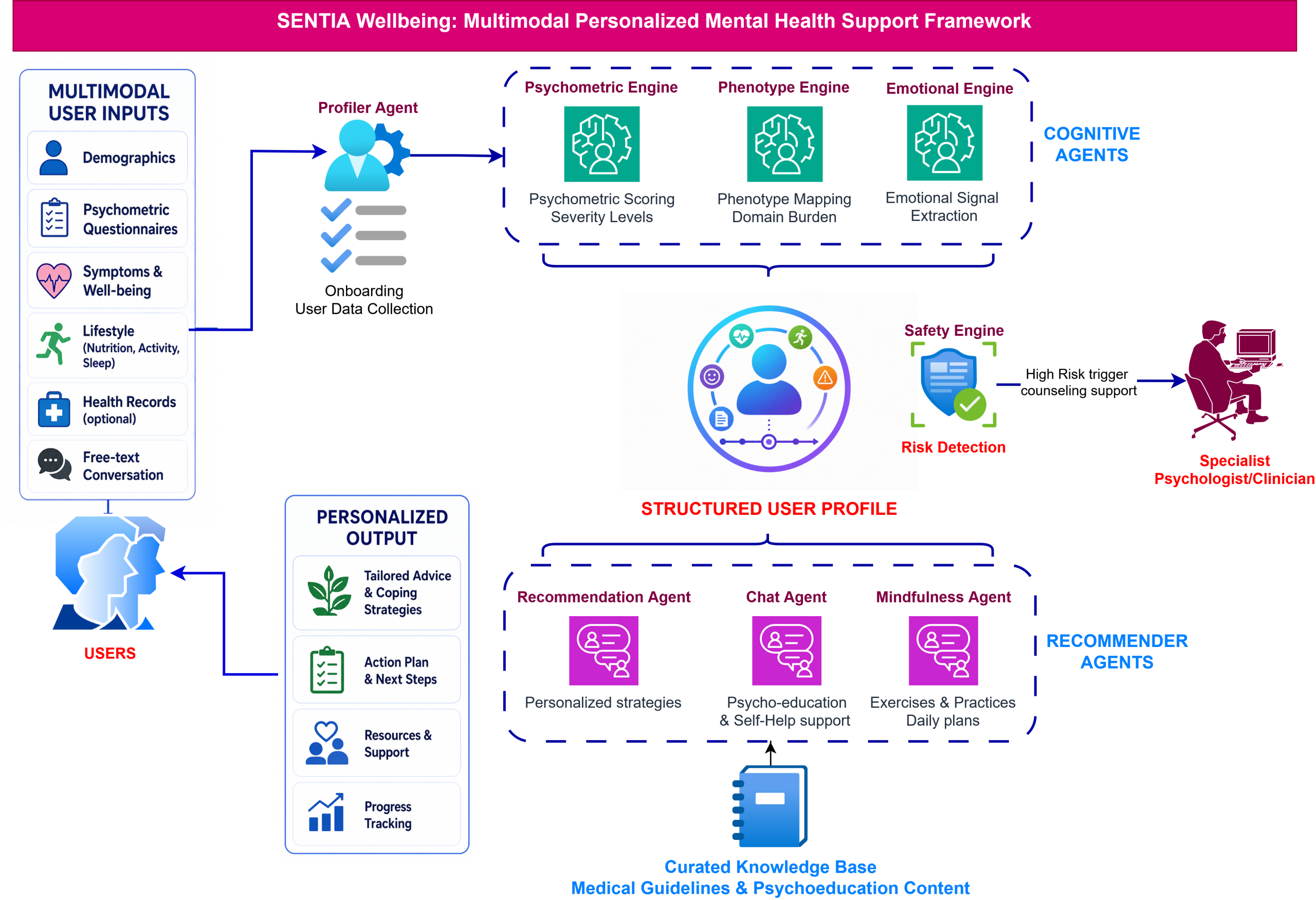
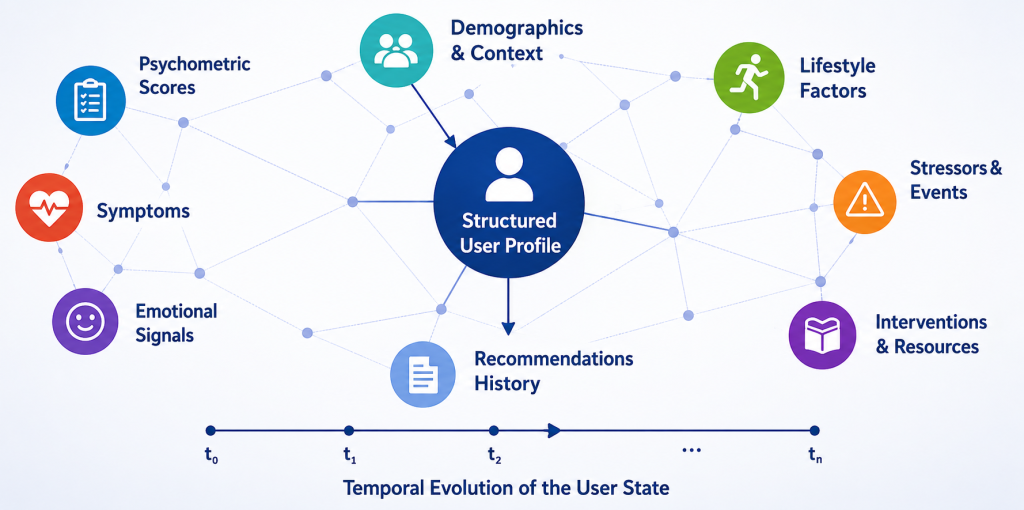
At the core of SENTIA Wellbeing lies the concept of a Structured User State, which serves as the central representation of each individual’s condition over time. This state integrates psychometric scores, reported symptoms, contextual stressors, lifestyle factors, and, where applicable, physiological and health-related indicators into a unified and continuously updated user profile. Rather than allowing free-form interactions between system components, all modules operate through this structured state, ensuring consistency, traceability, and interpretability of all outputs.
Ethical and Safety Boundaries
The framework operates under clearly defined clinical and ethical boundaries, ensuring that AI supports, rather than replaces professional judgment.
SENTIA Wellbeing is explicitly designed as a support system. It does not diagnose, prescribe medication, replace clinical evaluation, or provide emergency decision-making. The AI model is constrained to retrieval from verified documentation and cannot override deterministic risk logic.
Safety mechanisms include structured user state supervision, threshold-based risk classification, escalation protocols for critical cases, and psychologist confirmation requirements for flagged insights. This ensures that artificial intelligence remains assistive rather than authoritative.